In the UK alone, around 900,000 tons of bread (approximately 1.2 billion loaves) are wasted every year. Even if the estimated amounts vary across different sources, they still highlight a pressing issue that often goes unnoticed: the incredible amount of food that ends up in the trash instead of being redirected or used for new purposes. Today, we will have a look at a company which has an innovative solution to this problem by turning surplus bread into something quite unexpected: beer.
A Circular Economy in Action: Toast Brewing’s Creative Solution
Toast Brewing, a UK-based company, has taken a bold step to tackle the issue of food waste by integrating surplus bread into the production of their craft beer. By using bread that would otherwise go to waste, they are not only reducing food waste but also contributing to a more sustainable beer-making process.
This approach is a great example of the circular economy – a system where waste and surplus products are reintegrated into the supply chain rather than being discarded. It’s a replicable model for businesses of all sizes, helping to minimize environmental impact and maximize resources.
What It Looks Like in Practice
The company’s website describes their brewing process, explaining how surplus bread can replace a part of the traditional brewing grains:
- Sourcing Surplus Bread: The brewery collects dried breadcrumbs in 15kg sacks from bakeries, supermarkets, and the sandwich industry.
- Blending Ingredients: A mixture of 75% malted barley and 25% breadcrumbs is combined with hot water to release fermentable sugars. Each batch uses 115kg of breadcrumbs per 5,000 liters of water.
- Creating Wort: Barley’s natural enzymes break down starches to create a malty, sugar-rich liquid called wort. After separation and extraction, hops are added during a one-hour boil to introduce fruity, floral, and bitter flavors.
- Fermentation: Yeast is added to the wort, converting sugars into alcohol and CO₂ over a 10-day fermentation process, ultimately resulting in craft beer.
In a similar approach, as shown in the following DW video, a German brewery is using surplus bread to create non-alcoholic beer, further demonstrating how the circular economy is making its mark in the brewing industry:
Making a Difference
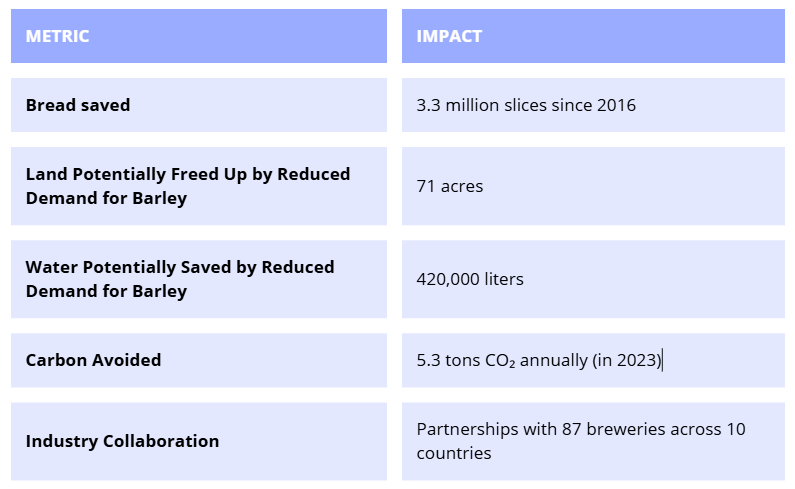
The following table is a snapshot of Toast Brewing’s sustainability achievements:
Repurposing bread not only reduces food waste but also addresses the environmental impact of bread production and disposal. Food waste in landfills generates methane, a potent greenhouse gas. Repurposing bread into a beer ingredient helps avoid some of this impact.
Using surplus bread in place of traditional grains also reduces demand for barley, a resource-intensive crop. By substituting a portion of barley, Toast Brewing has potentially freed up 71 acres of farmland and conserved 420,000 liters of water to date.
Although beer packaging remains the largest contributor to emissions related to the production of beer (50–60%), using surplus bread also lowers the environmental footprint of the brewing process.
And upcycling surplus bread is not the only example of circularity. According to their web page, the spent grain used in brewing is given to local farmers for animal feed, and spent hops are used for composting, demonstrating again how waste from one industry can serve another.
This article focuses on circular economy practices and rethinking waste. However, the company has been making efforts to improve all aspects of operating sustainably – from donating profits to charity to carefully choosing packaging in order to reduce its significant impact on the business’s overall carbon footprint. Toast Brewing’s impact extends beyond their own brewery—through partnerships with 87 breweries across 10 countries, they’re spreading the circular economy model and encouraging industry-wide change.
This shows how a single innovative idea—upcycling surplus bread—can lead to positive environmental and social change, setting an example worth following. In fact, if you read the company’s latest Impact Report, you may find interesting assumptions about the potential impact on land use, water, and energy consumption if more breweries adopt this practice. Fortunately, more and more businesses are exploring the use of surplus bread. For instance, the Italian Biova project, the US Modist or the Hong-Kong-based Breer are also embracing this innovative method to produce craft beer, further demonstrating how the industry is rethinking waste and transforming it into a valuable resource.
The Power of Small Businesses in Driving Sustainability
Toast Brewing’s approach proves that small businesses can make a big impact. Sustainability initiatives are often associated with large corporations, but this example shows that rethinking waste on a smaller scale can yield interesting results.
For small businesses, adopting circular economy practices doesn’t have to be complicated. The key lies in identifying opportunities to repurpose resources, collaborating with others, and tracking progress to measure impact (one loaf at a time…).
What We Can Learn from This Example
So, how can we start thinking about waste differently? Here are a few ideas for small businesses looking to implement circular economy practices:
- Identify Hidden Resources: What resources in your business could be repurposed or reused? Whether it’s food, materials, or even office supplies, there’s likely potential to reduce waste.
- Collaborate with Others: Consider partnerships with other local businesses to repurpose materials or resources that may otherwise go to waste. Collaboration is key to building a circular economy.
- Think Beyond Waste: Challenge yourself to look at waste as a resource that can be turned into something valuable—whether it’s a product, a service, or even an innovation.
- Measure Impact: Track your business’s waste and sustainability efforts. By measuring progress, you can better understand the environmental benefits of your actions and communicate those efforts to customers.
Every Step Counts
Toast Brewing’s example shows how a single, innovative idea can lead to positive change and inspire others. Whether you run a craft beer company or a small café, there are several ways to rethink waste and make a difference.
When combined, even small, intentional changes can be transformative. Let’s ask ourselves:
What can we do today to rethink waste and contribute to a more sustainable future?
This post is not sponsored and serves exclusively to highlight an inspiring example of sustainability and circular economy in action.
 Steps to Sustainable Business
Leave a comment