
Introduction
In a business environment marked by constant change, sustainable practices are now crucial for long-term success. For small and medium-sized enterprises (SMEs), implementing green initiatives can be resource-intensive and complex. However, green partnerships can provide an effective way to share resources and expertise, as well as accelerate sustainability efforts.
By collaborating with other businesses, academic institutions, NGOs, or government agencies, SMEs can reduce costs, drive innovation, and improve their reputation, while making a meaningful impact on the environment. This guide explores how to build, structure, and leverage green partnerships for real-world success.
The Value of Green Partnerships
Why Collaborate?
Green partnerships can help SMEs overcome limitations in budget, manpower, and expertise by:
- Sharing Knowledge and Resources: Access specialized skills and insights from partners like NGOs, academic institutions, and industry peers.
- Reducing Costs: Pooling resources can lower the financial burden of sustainability initiatives.
- Enhancing Credibility: Collaborating with reputable organizations builds trust with customers, business partners, and local communities.
- Accelerating Innovation: Joint projects can lead to creative and innovative solutions.
Identifying the Right Partners
Types of Partners to Consider:
- Non-Governmental Organizations (NGOs): Offer insights, community engagement, and practical sustainability strategies.
- Academic and Research Institutions: Provide access to research, technical expertise, and innovative ideas.
- Industry Peers and Local Businesses: Can help leverage synergies, share resources and best practices.
- Government Agencies and Local Councils: Often have access to financing, incentives, and pilot programs supporting green initiatives.
- Sustainability Consultants: External experts can offer guidance tailored to your business’s specific needs.
How to Build a Green Partnership: A Step-by-Step Guide
Step 1: Identify Areas for Sustainability Improvement
Before looking for partners, try to understand your own sustainability challenges and where improvements can be made.
- Conduct a quick internal sustainability audit: Look at areas such as energy consumption, waste management, supply chain emissions, and resource efficiency.
- Identify key pain points:
- What’s costing you money or reputation? High energy bills? Packaging waste? Transport emissions?
- Are you throwing away valuable materials? (e.g., unsold bread, excess fabric, used coffee grounds)
- Could you share resources with another business? Warehouse space, logistics, bulk orders?
- Set specific sustainability targets: Examples:
✔️ Reduce packaging waste by 30% within six months.
✔️ Lower water usage by 20% through conservation strategies.
 Why this matters: Understanding your exact sustainability needs and challenges helps make sure that partnerships are aligned with your real needs and strategic goals.
 Instead of forcing sustainability into your business, this approach lets sustainability solve a real problem for you.
 Example: A small bakery found they were throwing away unsold bread daily. Instead of wasting it, they partnered with a local craft brewery that now uses the leftover bread to brew beer.
Step 2: Research and Identify Potential Partners
Once your business knows what it needs, the next step is to find the right collaborators who can help you achieve sustainability goals.
- Choose the suitable type of potential partner (NGOs, academic and research institutions, other businesses, agencies and local councils, sustainability consultants).
- Talk to your suppliers. They might have solutions you haven’t considered (e.g., bulk eco-packaging options).
- Join small business groups. LinkedIn, Chambers of Commerce, and industry meetups are great places to connect.
- Leverage your customers. Sometimes even your own customers may be looking for sustainable business collaborations.
Why this matters: Partnering with the right business or organization increases efficiency, knowledge sharing, and impact.
Look locally first: Nearby businesses are often the easiest to collaborate with.
Example: A small café connected with a local farm and arranged for coffee waste to be used as organic fertilizer instead of being thrown away.
Step 3: Evaluate and Shortlist Partners
Not all potential partners will be a perfect match. Use the following criteria to evaluate them:
✔️ Is this a win-win collaboration? If only one business benefits, the partnership won’t last.
✔️ Are they reliable? Work with businesses that can commit to follow-through—not just good intentions.
✔️ Do they align with your values? You don’t have to be identical, but similar sustainability goals help.
Why this matters: A well-matched partnership ensures a successful, lasting collaboration rather than a short-term initiative.
Example: A small chain of zero-waste grocery stores partnered with a local glass jar manufacturer. They evaluated multiple suppliers but chose one that aligned with their sustainability goals, could consistently meet demand, and offered bulk discounts in exchange for steady orders. This ensured a reliable, mutually beneficial partnership that reduced packaging waste and costs for both.
Step 4: Define Clear Objectives and Responsibilities
Once a partner is selected, clarity is key to ensure a smooth collaboration. Have a clear, mutual understanding of what each partner is doing.
How to Set Up for Success:
✔ What’s the goal? (e.g., reduce packaging costs, eliminate food waste, switch to local sourcing.)
✔ Who does what? (e.g., one business provides excess materials, the other processes them into new products.)
✔ What’s the timeline? (e.g., try a pilot project for 3 months, then evaluate results.)
Why this matters: A structured partnership with clear rules reduces misunderstandings, keeps both parties accountable, and increases the likelihood of success.
Example: A restaurant and a composting startup agree that the restaurant would separate food waste, and the composting company would collect it weekly for free. They first agree to a trial period after which they will decide whether to proceed in the collaboration.
Step 5: Pilot the Collaboration & Measure Success
Before rolling out a large-scale initiative, it’s smart to test the partnership with a small pilot project.
Best Practices for a Pilot:
✔ Start with a limited trial (e.g., one product line, one location, or one-month test).
✔ Track savings & impact (e.g. measure waste reduction, cost savings, or efficiency improvements).
✔ Adjust as needed (e.g., If logistics aren’t working, refine them before expanding).
Why this step matters: A pilot minimizes risk and allows for adjustments before a full rollout.
Example: A group of small retailers in a shopping district collaborated to introduce a shared reusable bag program. Instead of each store offering single-use bags, they created a system where customers could borrow and return high-quality reusable bags at any participating shop. After a three-month test period, the program reduced plastic waste and improved customer engagement, leading to more stores joining the initiative.
Step 6: Scale Up & Communicate Success
Once the pilot delivers positive results, the next step is to expand gradually while promoting the impact of the partnership.
- Scale up the partnership. (e.g., include more locations or add new products.)
- Incorporate lessons learned (address issues from the pilot to improve).
- Promote it! Customers love real, local sustainability efforts.
- Bring in new partners. If your partnership is successful, other businesses may want to join.
Why this matters: Scaling up ensures maximum impact, while transparent communication builds credibility and attracts further opportunities.
Example: A group of independent bookstores piloted a “Pre-Loved Books Initiative,” allowing customers to return used books for store credit. After strong customer engagement, they expanded the program, partnered with local schools and libraries, and promoted it through social media. The initiative increased customer visits, reduced waste, and attracted more bookstores to join.
Bonus Tips for SMEs
✔ Focus on cost savings first. Cost-effective green initiatives are easier to implement and sustain.
✔ Think local first. The best partnerships are often right in your neighborhood.
✔ Make it easy. If it takes too much time or effort, businesses won’t stick with it.
✔ Keep communication simple. Be clear but don’t overcomplicate agreements—just align on goals and test first.
✔ Track the benefits. Even small changes can make a big difference over time.
Conclusion
Green partnerships don’t have to be complicated. Whether it’s sharing resources, cutting waste, or creating sustainable solutions together, collaborations can be a practical, profitable way to make your small business more sustainable.
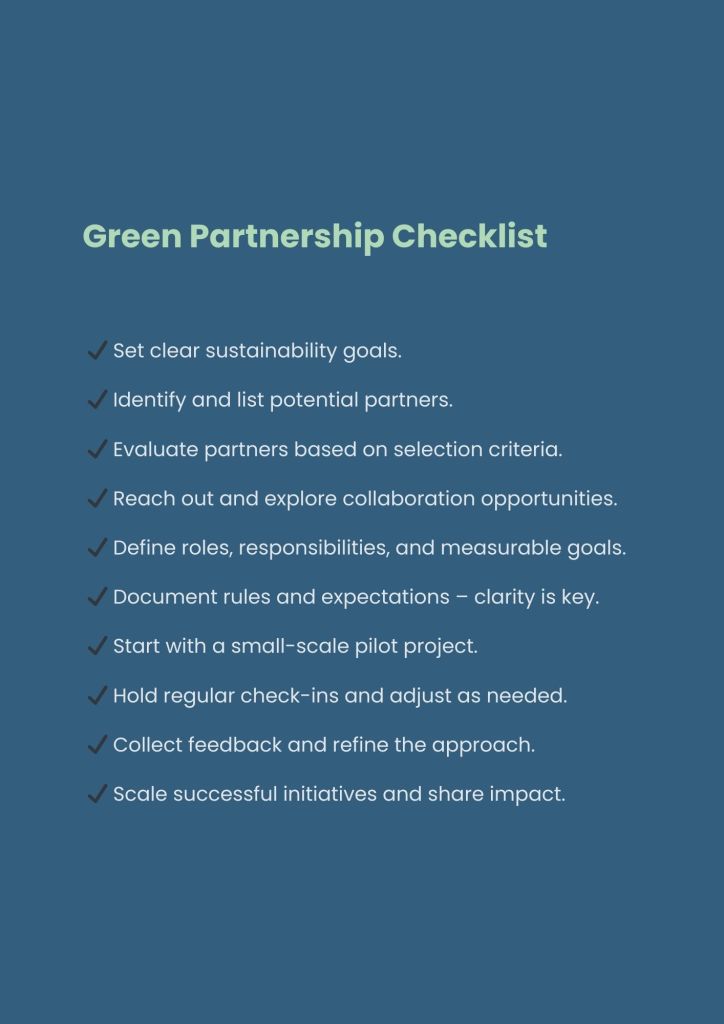
Embrace the collaborative spirit, use our checklist as a guide, and start building partnerships that lead to a sustainable future.
Have you ever partnered with another business or organization to advance your sustainability goals?
What challenges or successes have you experienced? Share your ideas in the comments!
 Steps to Sustainable Business
Leave a comment